


Yes, cats pee in the toilet once they learn the habit, and most cats pick it up faster than owners expect. The reason comes down to something cats already do on their own: perch on narrow, elevated edges. A cat balancing on a toilet rim is really just doing what it does on a fence post or a stair railing, so the training works with its instincts instead of against them.
That perching habit is why the switch from a litter box feels less strange to a cat than it sounds to a person. The box gets raised and narrowed in small stages until the cat is balanced right over the bowl, and the cat barely notices the change because the behavior underneath it never changes. What does take real attention is the order of those stages and how long to hold each one before moving to the next.
Table of Contents
Why Cats Can Even Learn This Habit
Digging in litter is a cat covering its scent to stay safe from predators, not a fixed requirement for where it goes. Once the surface under its paws stops feeling like loose granules, most cats drop the digging motion within a few sessions because the instinct was about the texture, not the box itself. That's documented behavior worth reading about on Should You Train Your Cat to Use the Toilet?, which covers the same shift from a trainer's view.
A cat's balance and grip strength do the rest of the work once digging fades out of the routine.
| Litter Box Habit | Toilet Habit |
|---|---|
| Digs to bury scent | Skips digging on a hard rim |
| Squats flat on loose litter | Balances on a narrow ring |
| Steps in and out at floor level | Hops up and down from a raised seat |
| Covers waste after each use | Lets the flush clear it instead |
This short video shows how a trainer walks a cat through that shift step by step.
Veterinarians and trainers who work with older or anxious cats often point to this same pattern: the behavior carries over, only the surface and height change. For a deeper look at the biology behind it, see how cats are naturally potty trained.
How Cats Learn to Balance Over the Bowl
A cat learns to balance over an open bowl by shifting its weight onto its hind legs and gripping the rim with its front paws, the same stance it already uses on a fence rail or stair post. That grip only works if the surface under its paws holds still. A seat that rocks or slides even a little will spook a cat mid-squat, and one bad scare can set training back several sessions.
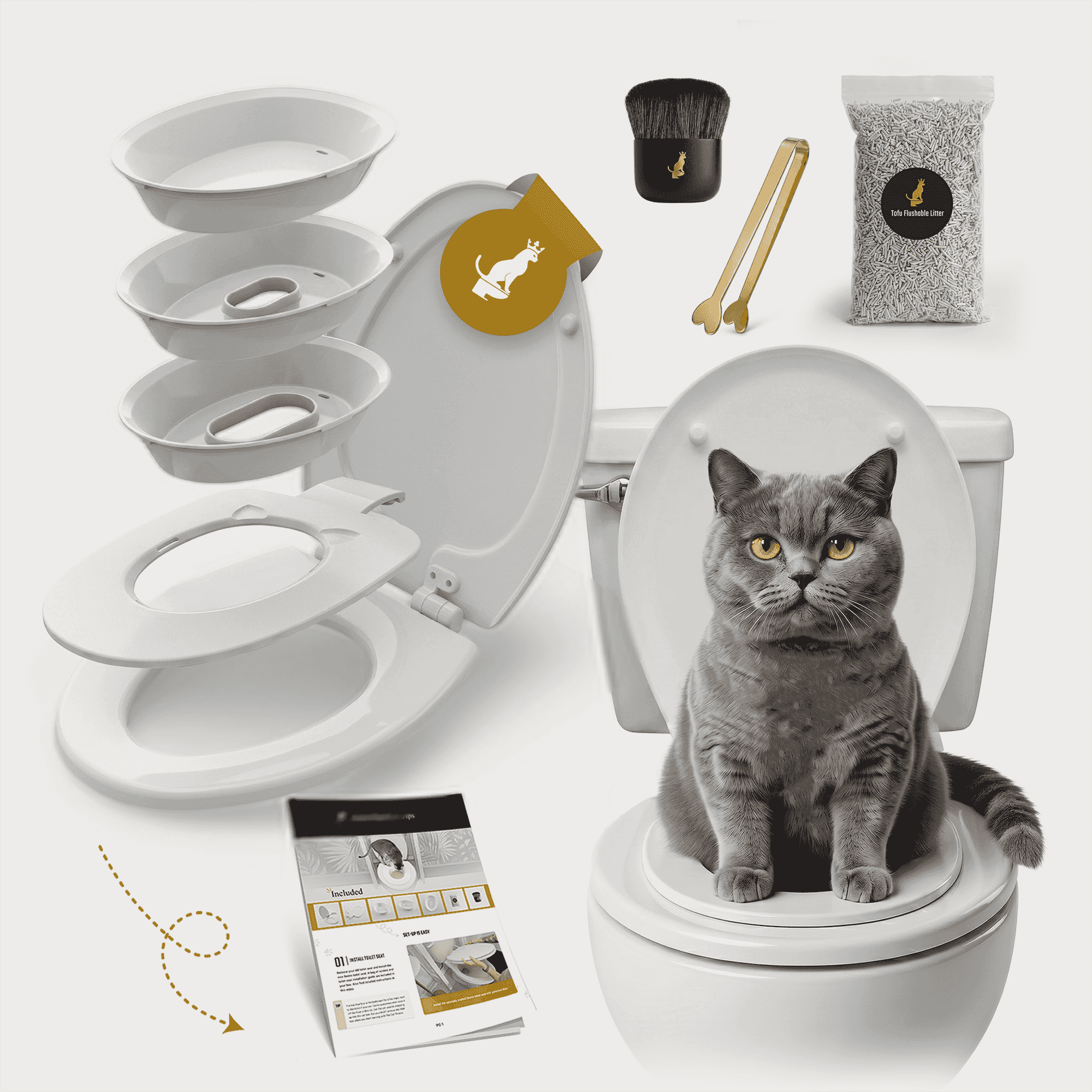
The Cat Throne System
A solid seat, like the Cat Throne toilet seat, keeps a cat's attention on the task instead of on staying upright. Confidence here doesn't arrive in one sitting. It builds across short, repeated sessions, usually a few minutes at a time, until the cat stops checking its footing and just goes.
- Paws lock in place instead of shifting mid-squat
- Cat stays in position for the full visit
- Cat returns to the seat on its own next time
- No hesitation or pacing before stepping up
The Step-Down Method That Actually Works
The step-down method moves a cat from a litter box to an open bowl in stages small enough that it never feels like a jump. Start with a litter-filled training tray set on top of the toilet seat, so the cat keeps its normal routine while its body adjusts to the new height. From there, the opening in the tray shrinks a little every few days as the cat adjusts, not all at once.
Litter only comes out of the picture once the cat squats comfortably over the hole on its own, with no pausing or stepping around the ring. The Cat Throne System ships with graduated rings built for this exact sequence, so owners aren't guessing at sizes between stages.
Picking a Toilet Setup That Won't Scare Your Cat
A loose or shifting seat is the top reason cats quit mid-training, full stop. Even a small wobble during a squat reads as danger to a cat, and most won't give the seat a second chance that same day.
Wood construction with a slow-close hinge cuts down on the sudden bang that plastic seats make, which matters in households with kids who forget to ease the lid down. Fit matters just as much: a seat has to sit flush on both round and elongated bowls, the two standard shapes found in most homes, or it rocks no matter how careful anyone is. The Patented USA Toilet Seat is built to stay solid under a cat's full weight, which is the actual job a training seat has to do.
- Check for any side-to-side give before training starts
- Confirm the seat matches your bowl shape, round or elongated
- Pick a slow-close hinge over a standard one
- Test the seat with your own hand pressure before the cat does
Common Setbacks and How to Handle Them
Accidents near the toilet almost always mean the ring shrank faster than the cat could follow, not that the method failed. That kind of stress-related house soiling is documented in Cornell's feline behavior research, and the fix is usually the same: slow down.
Older cats and cats with joint pain often need a slower pace through every stage, since hopping onto a raised, narrow seat asks more of their hips and knees. For cats past middle age, it's worth reading how older cats learn toilet training at their own speed. Going back one ring size is a normal correction, not a failure, and multi-cat homes often do better staggering each cat's schedule so one isn't rushed to match another.
- Accidents nearby: move back one ring size for a few more days
- Stiff or hesitant hops: slow the stage-to-stage timeline
- Refusing the next ring: hold the current size longer before trying again
- Multiple cats: train one at a time on separate schedules
Which Households Should Try This First
Small apartments change the math on toilet training. A studio in a dense building has nowhere to hide a litter box smell, and every bag of clay litter a renter hauls to the curb adds up over a year. Owners already thinking about waste and odor in a small footprint tend to stick with the process longer than owners who took it on for a novelty.
Very young kittens and senior cats sit on the other end. A kitten under six months is still growing the hind leg strength that balancing on a narrow ring requires, and a senior cat with early arthritis faces the same hip and knee demand when a cat should start toilet training gets decided by the vet, not the calendar. Waiting a few months costs nothing, while pushing a cat whose joints aren't ready usually ends in a stalled program and a frustrated owner.
A seat that doesn't wobble removes most of the guesswork that turns a normal setback into a quit. Households that skip a stable base end up re-running the same stage over and over because the cat keeps spooking at the same wobble, not because the method is wrong.
| Household | Likely outcome | Main cost involved |
|---|---|---|
| Urban apartment, eco-conscious owner | Fast adoption, high follow-through | Upfront seat and training kit |
| Family with kids under 10 | Steady progress with supervision | Time spent on staggered stages |
| Kitten under 6 months | Best to delay a few months | Ongoing litter during the wait |
| Senior cat with joint pain | Slower stages, vet input needed | Longer timeline, same equipment |
Litter itself is the recurring cost that toilet training removes. A household buying a 20 to 40 pound bag of clay litter every few weeks spends more over two or three years than the price of a one-time seat and training kit, which is why owners who plan to keep the cat long term see the bigger return.
Picking the Seat You'll Start With This Week
Pick a seat that won't shift under your cat, set it on the bowl, and start the first stage this week rather than waiting for a perfect moment. A wobble on day one does more damage than a slow pace ever will, so stability matters more than speed at every step. Give each ring size the full three to five days it needs before shrinking it again, even if your cat seems ready sooner. The Cat Throne System comes with the seat and graduated rings already matched, so you don't have to build a setup from separate parts and hope they line up. Patience, not pace, is what gets a cat fully off litter.
Toilet Training Questions Owners Still Ask
Will my cat's claws scratch or damage the toilet seat over time?
Claws can leave light marks on soft plastic seats, but a hardwood seat holds up much better under daily gripping. The Patented USA Toilet Seat is built from durable wood specifically so repeated paw pressure and gripping during balance training don't wear it down or loosen the fit. A scuffed surface won't affect how well your cat grips during a squat.
Can I still flush normally while my cat is mid-training?
Yes, flushing stays normal through every stage. The only time to hold off is right after your cat steps down, since a loud flush close to a startled cat can undo a session's progress. Wait until your cat has left the bathroom, then flush as usual.
What happens if guests or kids use the toilet during training?
Household members can keep using the toilet as normal during training, including with the training ring in place. Just ask guests and kids to lower the seat gently rather than letting it drop, since a bang against the bowl can spook a cat that's mid-stage and set its confidence back. A slow-close hinge handles this automatically if anyone forgets.
Do male cats spray or miss the bowl more than female cats during training?
Sex alone doesn't predict accuracy at the bowl. An unneutered male is more likely to spray near the toilet out of marking behavior, but that's a hormonal issue, not a training one, and neutering typically resolves it. Spayed and neutered cats of either sex generally aim and balance the same way once they've built up grip strength on the rim.