


Cat litter that doesn't track usually comes down to one thing: grain size, not your cat's habits. A single paw can pick up dozens of tiny litter particles tucked between its toes, and some of those bits travel ten feet or more before they shake loose on your kitchen floor. It isn't because your cat is sloppy. Fine, dusty granules cling to fur the same way sand clings to wet skin, while larger grains fall away at the box edge before your cat ever takes a step.
This matters most for households where floors get walked on barefoot, crawled on by toddlers, or inspected closely by anyone with allergies. Vets and trainers who deal with litter box issues all day will tell you the same thing: switching to a coarser, larger-grain litter solves tracking faster than any mat or rug ever will. The paw just can't hold onto bigger pieces, so less litter leaves the box in the first place.
Table of Contents
Why Some Litters Travel Further Than Others
Static and leftover moisture are the real glue behind tracking. A damp paw pad picks up fine dust the same way a static balloon grabs hair, and that dust rides along until the cat steps somewhere else. Larger, rounder grains don't have the surface area to cling the same way, so they drop off almost as soon as the paw lifts.
Shape matters as much as size. Round pellets roll off a paw pad with normal walking motion, while flat or jagged fines wedge between toe pads and stay put for several steps. That's the mechanical difference between a litter that stays in the box and one that ends up on the hallway rug.
Clay and crystal litters are milled into smaller, irregular pieces to help with absorption, which raises their dust output. Tofu and paper litters are usually extruded into larger, more uniform pellets, so they naturally shed less fine powder. Anyone dealing with litter tracking around the house will notice this difference within a week of switching.
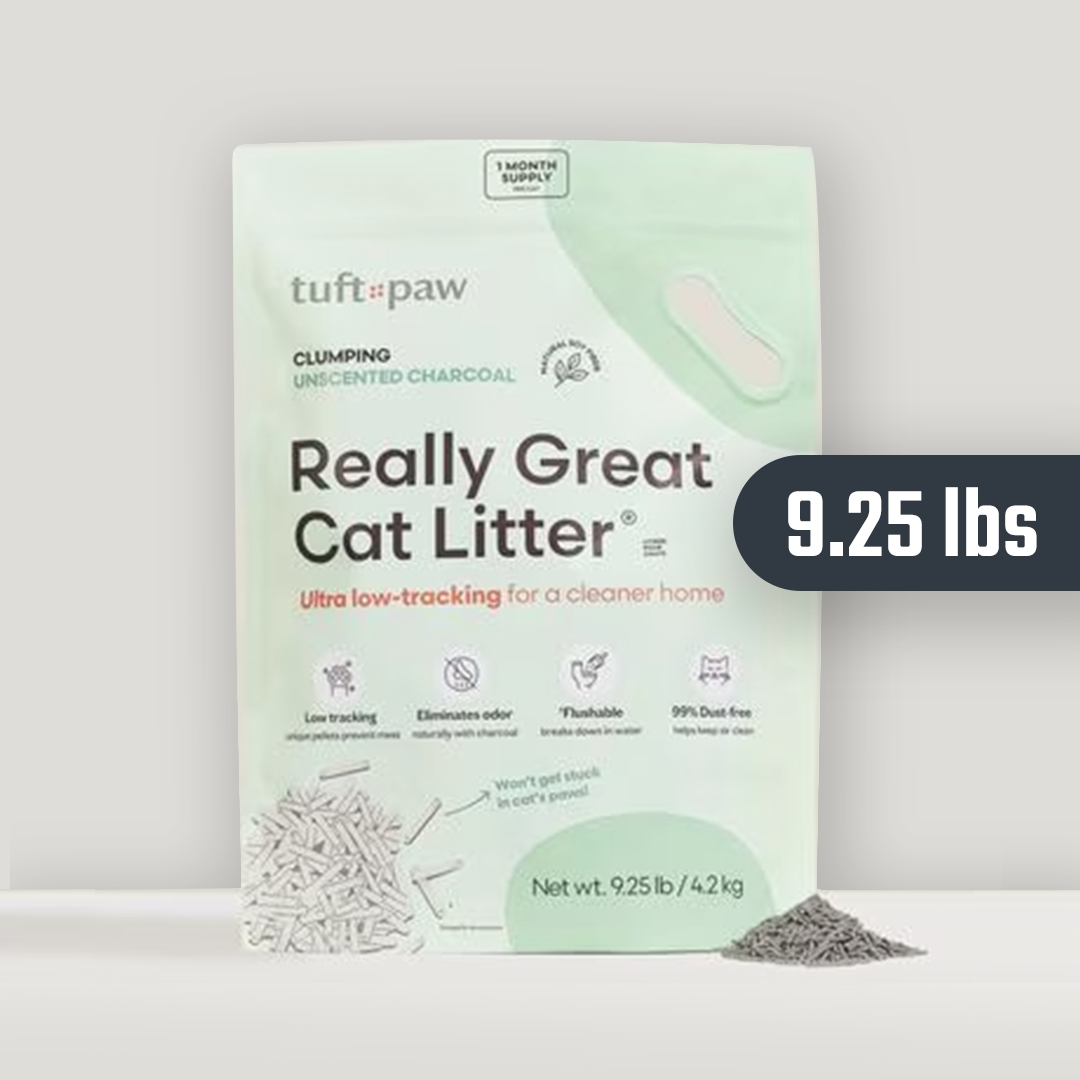
Tuft & Paw Tofu Flushable Litter
| Litter Type | Average Particle Size | Dust Level |
|---|---|---|
| Clay | 1-3 mm | High |
| Silica crystal | 2-5 mm | Moderate |
| Tofu | 4-6 mm | Low |
| Paper pellet | 5-8 mm | Low |
What Makes a Litter That Doesn't Track
A litter resists tracking when its grains are too big and too heavy for a paw pad to hold onto. Fine granules work into the soft fur between toes, while chunkier pieces just roll off the moment your cat steps forward. The shape matters too: round or blocky grains shed faster than flat or splintered ones, since there's less surface for them to catch on.
Dust plays a separate role. A low-dust formula means fewer loose particles settle on the floor around the box in the first place, which matters for anyone with allergy-prone family members or clients in a clinic waiting room. A mat by the box only catches what already made it out, so it's a backup, not a fix. Compare a litter against these points before you buy a bag:
- Grain size listed on the bag, bigger generally means less tracking
- Dust rating or a "low-dust" claim on the label
- Whether the litter clumps whole or crumbles into fines
- How the litter feels between your fingers, gritty versus smooth
Materials That Naturally Resist Tracking
Material drives tracking more than brand marketing ever will. Clay litter is milled fine to absorb liquid fast, which also makes it the worst performer for tracking since the powder clings to damp paws. Silica crystal beads look chunky, but they're often coated in a sharp dust that works into carpet fibers and stays there for days.
Tofu litter is extruded into larger, lighter pieces that clump on contact with moisture without breaking into powder underfoot, which is why trainers and retailers who stock it hear fewer tracking complaints than with clay. Paper pellets track even less than tofu in most cases, but they soak up odor poorly and need more frequent full changes. A quick comparison for the shelf:
- Clay: heavy dust, tracks easily, cheap per bag
- Silica crystal: sharp dust, moderate tracking, slow to need changing
- Tofu: low dust, large grains, clumps whole
- Paper pellets: lowest tracking, weaker odor control
Independent testing from Consumer Reports backs up the dust difference between these material types, which is worth a look if you're weighing options for a multi-cat household.
Tuft And Paw Versus Cat Throne Tofu Litter
Both litters solve tracking the same way, with large tofu grains, but they differ on scent and bag size. Tuft & Paw comes in Charcoal, which is unscented, or Lavender, a light natural scent, priced at $28 and rated 99% dust-free. The Cat Throne's large-grain tofu litter runs $23 and ships in a 5.5 lb bag for full households or a 1 lb bag for testing it on a new cat.
Both are flushable and biodegradable, which matters to anyone trying to cut clay and plastic out of their trash. Neither one needs a litter liner or a scoop built for clumping clay, since the grains break down differently. Here's how they stack up on the points that actually affect a buying decision:
- Price per bag: Tuft & Paw $28, Cat Throne $23
- Scent choice: Tuft & Paw has two, Cat Throne is unscented
- Bag size: Tuft & Paw one size, Cat Throne offers 5.5 lb or 1 lb
- Flushability: both are septic-safe and biodegradable
If scent control matters to your household, the Tuft & Paw Tofu Flushable Litter gives you a choice; if you'd rather test a small amount first, the Flushable Tofu Cat Litter comes in a sample size for that.
Habits That Cut Tracking Even Further
Even the best tofu litter tracks more if the box is overfilled. Keep the fill around two to three inches deep, since loose grains piled higher than that spill over the edges every time your cat digs. Box placement matters just as much: a box tucked in a quiet corner sees less paw-to-floor transfer than one sitting in a hallway your cat walks through a dozen times a day.
A textured mat right outside the box catches whatever grains make it that far, working as a second line of defense rather than the main fix. If you're switching litters, do it gradually over seven to ten days by mixing the new litter into the old, since a sudden swap can trigger extra digging that kicks more granules out of the box. A few habits worth locking in:
- Fill depth between two and three inches, no higher
- Box placed away from main walking paths
- Textured mat placed directly at the box exit
- Gradual seven- to ten-day litter transition
Material Swap or Full Setup Change
Switching to a larger-grain litter solves most of the tracking problem, but not all of it. Cats with long fur between their paw pads, think Maine Coons or Ragdolls, pick up more grains regardless of what's in the box, since the fur itself traps particles the same way a mop head does.
For those cats, a material swap alone won't get you to a clean floor. Pairing the litter change with a mat at the box exit and a quiet, low-traffic box location gives the biggest drop in cleanup time, more than either change makes on its own.
- Long-haired cat, clay litter: heaviest tracking, needs full setup change
- Long-haired cat, tofu or paper litter plus mat: moderate tracking, manageable
- Short-haired cat, tofu or paper litter alone: light tracking, often enough on its own
- Short-haired cat, clay litter: still tracks more than needed, easiest fix
Retailers and clinics stocking litter for multi-cat households should expect the long-haired cases to need both changes, not just a bag swap. One more trade-off worth naming: flushable tofu litter also cuts out the trips to the trash with a heavy clay bag, since used tofu grains go down the toilet instead. That's a separate win from tracking, but it adds up for anyone managing several boxes, which the cost comparison on tofu versus clay breaks down further.
What to Buy Next for a Cleaner Floor
Skip clay and crystal and put a large-grain, flushable tofu litter in the box. Buy one full bag and use it start to finish before you decide if it works, since a half-bag trial won't show you how your cat settles into new grains underfoot. Place the box in a low-traffic spot, use 2 to 3 inches of fill, and put a textured mat at the exit. If scent is a factor in your house, The Cat Throne's large-grain tofu litter gives you an unscented option to start that trial with. That combination- the right material, the right depth, the right placement- is what actually keeps grains off your floor.
Cat Litter Tracking Questions
Will a low-tracking litter still work well in a covered litter box?
Yes, but a hood changes the physics a bit. Covered boxes trap more humidity inside, which can make grains stick to a damp paw before your cat steps out. Pick a large-grain tofu or paper litter over clay in a covered box, since the bigger pieces still shed faster even with the extra moisture, and wipe down the entry flap weekly where dust tends to build up.
Does a multi-cat household need a different approach to stop tracking?
You need more boxes, not a different litter. The standard rule is one box per cat plus one extra, so three cats call for four boxes spread across low-traffic spots. Buying a large bag, like the 5.5 lb Cat Throne Tofu Flushable Litter, keeps every box filled with the same grain size without forcing you to restock mid-week.
Why does my cat still track litter even after I changed brands?
Check the fill depth and box placement before blaming the litter. A new low-tracking formula still sheds if the box sits too full or right in a hallway your cat crosses often. Long fur between the paw pads also carries grains regardless of brand, so a mat at the exit and a quieter box location usually close the gap the litter switch alone didn't.
Is flushable tofu litter safe for older pipes or a home on septic?
It's built to break down the way toilet paper does, so most home plumbing and septic systems handle it fine. Older cast iron or clay pipes with existing blockages are the exception, since any solid waste can back up in a line that's already narrowed. If your home has a history of slow drains, ask a plumber before flushing litter daily instead of scooping it into the trash.